|
|
|
| |
| |
👋 Good morning. The election memes are back, and honestly, good. There was something about 2023 that felt different. Nigerian youths showed up in a way that had never quite happened before. I remember exactly where I was the day I voted, and I remember what it felt like to believe that showing up mattered. That feeling did not last as long as we deserved. But if the memes bring even a fraction of it back, let them run. Some things are worth chasing twice. As always, there is something for everyone this week, scroll to the end, do not skip. |
Let’s get into it ⬇️ |
In this edition: This week in culture, the death of film criticism, running Accra streets, and more. |
If you’re enjoying this, don’t forget to subscribe and join The Juice community. We’re building this together ♡. |
 |
Shalom Tewobola,
Editor.
|
|
|
|
|
| |
|
|
| |
| |
Quick Question |
What’s the longest-running telenovela in Nigeria? |
Answer at the bottom of this newsletter |
|
|
|
| |
|
|
| |
| |
🗞️ THIS WEEK IN POP CULTURE |
|
|
🎵 MUSIC |
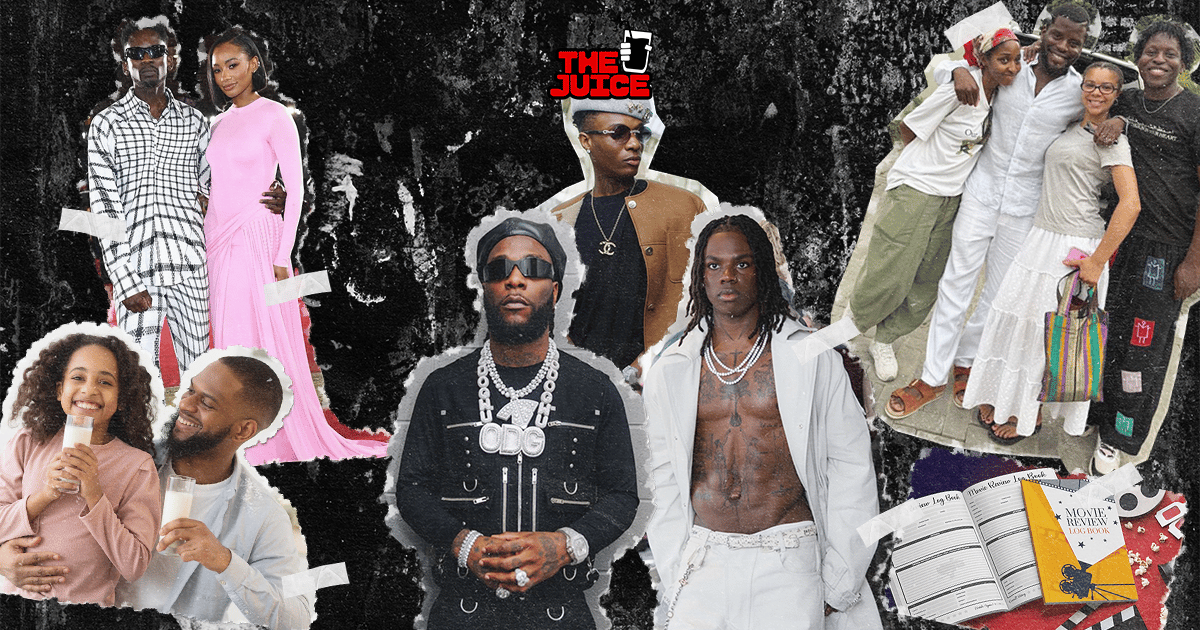
Rema, Wizkid, and Burna Boy landed nominations at the American Music Awards. Afrobeats has really come a long way. We couldn’t be more proud! |
|
|
📸 CELEBRITY |
Temi Otedola and Mr Eazi are in the news again, but this time for their conflict resolution. Apparently, Mr Eazi finds it easier to express himself via email than in a face-to-face conversation. And to be honest, as writers, we are clearer on paper, so we get him. |
|
|
📚 LITERATURE |
If you’re a book lover, digital reader Storipod just made your life easier! They struck a deal to distribute our Odeluwa; Chimamanda Ngozi Adichie’s books, digitally. |
|
|
📽️ FILM |
Everybody say up Nigerian cinema! The Esiri brothers’ Clarissa has been selected for the Directors’ Fortnight at Cannes 2026. The film will screen alongside 18 other features selected for the section. |
|
|
↝ TRENDING |
Gst has been accused of pushing sensationalist media. When asked about their fact-checking ethics, the media house insinuated that influencers are being paid to “cheer Nigerians towards harm.” We don’t get the correlation, but it is what it is. |
|
|
|
| |
|
|
|
| |
| |
MAIN SQUEEZE |
5 Nigerians on why they got their PVCs |
It has become abundantly clear that the 2027 presidential elections are upon us. Throughout the week, people were rushing to complete their voter registration, seeing as the second phase of the Continuous Voters Registration (CVR) ends on Friday. |
This year, there seems to be less apathy and more enthusiasm about the upcoming elections. We spoke to a few Nigerians who have decided to vote in the next election. They tell us why they are voting next year. |
Their answers range from disdain for President Bola Ahmed Tinubu, also known as BAT, to a sense of civic duty. |
Josiah |
The first time I was eligible to vote was in 2019, but I was in my final year, and the year leading up to it was so stressful that I didn’t bother. Maybe I was just apathetic. |
In 2023, I really wanted to vote. I even volunteered, helping people complete their online registration; we moved from location to location. I did mine too, but the biometrics process was a hassle. |
I tried for three straight days and still couldn’t complete it, so I ended up not voting. This year, though, I’ve promised myself I’ll follow through with the entire process and actually vote. |
Eloho
I’ve never voted before. I tried to get my voter’s card the first year I was eligible, but they gave me the runaround until I gave up. That was in 2015. Now, I’m ready to try again. The country is going to shit, and I’m tired. |
When I saw how easy the online registration was, I did it immediately. A few weeks later, I went to the office for verification. Now I’m just waiting to get my PVC. Fingers crossed. Let’s vote out the cankerworm. |
Ire |
I didn’t vote in the last election because I had just graduated. I knew Nigeria had problems, but they hadn’t really hit me yet. I was aware things were bad, just not that bad. |
Four years later, it’s different. Things have become really difficult, and I feel it now. So I know I need to take my civic duty seriously. |
Nimi |
I have never voted, but I’m voting this year because I want to feel like I made an actual decision, regardless of where it ends. |
Stan |
I don’t want to be among those who complain about the country but do nothing about it. I know we often say our votes don’t count, but Tinubu didn’t even win Lagos in the last election; there’s a reason they “buy” votes. So no matter how it turns out, I’ll know I did my part. |
|
|
|
|
|
| |
|
|
|
| |
| |
🔪 THE PEEL |
|
|
Inside the death of film criticism |
During the week, Nollywood Twitter (now X) had one of its usual discourses. It is one of the popular ones: filmmakers vs critics. This time, it was sparked by an up-and-coming filmmaker, Idiagi Ernest, who made a tweet. |
His tweet read, “The fact that film criticism is an actual job burst my head. Like your job is just to talk about what other people did.” |
It was clearly sarcasm. Anyways, I started thinking about what this filmmaker’s career would look like if critics decided to never engage with his film. |
|
|
|
| |
|
| |
| |
Peeling it back |
Now, to really paint a picture of what turning back on that filmmaker would look like, I feel the need to explain film criticism. |
Criticism is more than 'this film is bad/good'. It is an interpretation of art with much-needed context. Kind of what I do on The Juice every week, where I take a trending topic and break it down for you. |
Andre Bazin explains it better: “The function of criticism should not be to tell the artist what he must do, but to help him and others understand what he has done.” Going by this, it means that criticism is not an attack but a participation in the film’s life cycle. |
How does it participate in the film’s life cycle? |
If there are no reviews, it means no sustained conversation. Films rely on word of mouth and media discourse to keep them moving. |
Why do you think you were convinced to see Sinners or Behind the Scenes? Yes, there were adverts, but the media participation made you go see it. |
For example, with Sinners, many people wanted to shame Variety for an article they published, which positioned the film as a flop. Then came the reviews and more reviews that energised the audience. |
Critics stretch the timeline of a film. It goes like this: Opening weekend → analysis → retrospectives → think pieces. |
Reviewed films live in articles, essays, and rankings. Without these, guess what happens; films die at the box office or streaming window. It is because of critics that some films are discovered by the audience. |
When critics don’t glance at your film, it is lost in history. Publications act as archives. |
Years later, when people google “Themes in Nigerian Cinema” or “Best Films of 2026,” your film will show up if critics engaged with it. |
Without criticism, films become hard to trace historically. So critics don’t just talk about what people did; they preserve what they did. |
|
|
|
| |
|
| |
| |
Another layer |
Let’s not forget about the money part. When a film is written about, it becomes searchable; its SEO is being built, and it becomes referenceable. |
Investors, programmers, and collaborators look for press coverage and critical reception when deciding to invest. |
Filmmakers use reviews in pitch decks, grant applications, and festival submissions. If critics don’t cover your film, you lose this leverage. Criticism can become part of a filmmaker’s currency. |
You know what honest criticism also does? |
It helps filmmakers identify weaknesses and refine craft. If you only look at box office numbers and listen to praise from fans, you may never grow as a filmmaker. |
Critics keep filmmakers on their toes, or else they will fill up on faux praise and be lost to mediocrity. |
|
|
|
| |
|
| |
| |
The core |
In the end, a bad review still means your film was seen, engaged, and remembered. It’s like that saying, “bad press is still press.” |
No press at all? That’s digital death. So, it’s up to filmmakers to choose which end of the wishbone they would like to part with: silence or visibility. |
|
|
|
| |
|
|
|
| |
| |
🎵 PRESSED BY THE JUICE |
|
|
We are still in love. The country is tough, please. Between the Lagos traffic and the dwindling economy, love is what is keeping us alive. If you also want to stay alive like us, then listen to our playlist. We’ve got Tems, Somi, Magixx, and many others fanning the flame of loveeee ❤️ |
Don’t forget to save, we update frequently. |
Interested in guest curating? Reply to our mail, thejuice@pulse.ng |
|
|
|
|
|
| |
|
|
|
| |
| |
🏃💨 ON THE RUN |
|
|
Mundo Run Club Turns One in a City That Can't Stop Running |
There's a new run club popping up in Accra almost every week now, two events on a typical weekend, sometimes three, each pulling impressive crowds. |
Mundo Run Club sits somewhere in the middle of that wave: older than half the clubs that exist today, younger than the other half. Last month, they celebrated their first year with a run. |
We sat down with Zulfiquer Gbedemah, one of Mundo's conveners, to hear what it's actually like to build something amid all this momentum. |
What was the moment that made you think Accra needed this? |
For us, it all started as a simple group of friends who loved running for fun. We’d run together, but we realized we needed a bit more structure and planning to keep our runs consistent and purposeful. And that’s really how Mundo Run Club came to life. |
What’s an achievement you’re most proud of? Are there stories of people and places you have reached and inspired? |
We just celebrated our one-year anniversary! It was incredibly fulfilling! So many people showed up, and we had a huge turnout. Seeing new faces and getting people who had never run before is something we’re really proud of. |
What does the community actually look like from the inside — the stories, the people, the things you didn't expect? |
From the inside, it's ordinary people who love running, and people who never thought they would. Watching someone who came out for the first time, nervous, cross a finish line — and then come back the week after — that's what the community actually looks like. |
How has Mundo changed from what you first imagined it would be? |
At first, it was just a small group of us living close by. Two, three, maybe four people, just saying, “Hey, let’s run together.” But it grew so much bigger. |
Now, the community stretches across the city, and we even have members joining from all over the world. It’s amazing to see how far we’ve come. |
What would it mean for Mundo to have truly done its job in Accra's running scene? |
Running is one of the most accessible sports, but that doesn't mean everyone feels it's for them. |
If Mundo has done its job, it means we've changed that, at least for some people. Invited them in. Helped them believe they could do it, and then watched them go further than they thought. |
Written by Edudzi Nyomi, run club founder and community member |
|
|
|
| |
|
|
|
| |
| |
What's the longest-running telenovela in Nigeria? |
|
|
|
|
|
| |
|
|
|
FRESH STATS |
3.1 B According to the 2026 Africa Creator Economy Report, the sector is valued at $3.1bn. |
|
|
|
|
|
Today’s email was brought to you by Shalom Tewobola and Praise Okeoghene Vandeh. Editing by: Shalom Tewobola. Designs by: Daniel Banjoko |
|